Armand
The Vampire LestatArmand is the auburn-haired leader of a Parisian vampire coven whose authority is tested and ultimately broken by Lestat. He appears first as a compact, youthful figure whom Lestat distinguishes from Nicolas, then as the silent center of a gathering whose members look to him for rescue and order. His history of leading the coven is inseparable from its inherited rules: in defending them, he describes a vampire tradition of death, initiation, burial, and religious prohibition. Yet when that tradition can no longer hold the group together, Armand’s quiet declaration that it is finished makes his loss of authority unmistakable. Later, he seeks a bond with Lestat through an offer of shared knowledge and strength, but the intimacy is shadowed by their conflict and by Lestat’s sense of danger.
Identity and Introduction
Lestat first sees Armand during the encounter with the coven, when a small figure appears in an open doorway. The figure is a young boy rather than a man, but Lestat immediately knows it is not Nicolas: it is smaller than Nicolas and more heavily built. That resemblance matters as a moment of expectation and disappointment, not as evidence that the two are related. The figure’s appearance also establishes the contrast that will define Armand’s role in the confrontation: he is physically slight, yet he is the leader toward whom the coven’s attention turns.
Armand’s authority is evident even when he does not speak. After Lestat rebukes the group and a defeated boy vampire calls on Armand to bring the coven to order and save them, Armand remains silent. The appeal identifies him as the person expected to act, while the silence makes visible the distance between his former position and his ability to command events now.
The Coven’s Order and Its Collapse
Armand’s leadership is rooted in a religiously framed understanding of vampire life. A dark-eyed woman in the coven says their leader is Satan and that they serve him as they are meant to. Lestat asks why, and the gathering is left in consternation. The exchange reveals a group accustomed to treating its creed as an answer in itself, while Lestat’s question exposes the difficulty of defending that belief when challenged directly.
Armand’s account of the old order gives its beliefs a specific structure. He says that vampires of earlier times preyed on humans by night and that candidates had to prove themselves through a hundred crimes before receiving the Dark Gift. To be transformed, they appeared to die before their loved ones, endured the terror of the coffin, and were sealed in the grave again until thirst gave them strength to escape. Those who failed to break free received no mercy; those who rose became fledglings, granted less than the full power of an ancient master so that they might acquire wisdom before growing strong.
He describes the Rules of Darkness as governing both a vampire’s place in the world and the limits of its conduct: live among the dead and return to a grave or something like one; shun places of light; draw victims away from other people; honor God and the power represented by the crucifix and Sacraments; and never enter the House of God. Armand presents these prohibitions as mysteries that the old queen and Magnus have scorned and shattered. His defense is not simply a catalogue of customs: he treats them as a binding inheritance that gave the coven’s existence meaning and imposed limits on its power.
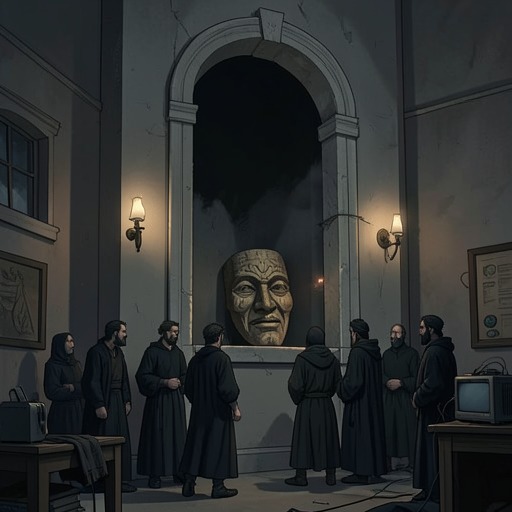
But the coven’s appeal to this inheritance cannot restore its command. When the defeated vampire calls on Armand to save them, Lestat instead tells the group to wash in the Seine, dress like humans, and move among people. The coven’s attention turns toward its leader, including the mad queen vampire. Armand then whispers, “It is finished.” The line marks the collapse of the order he has been trying to defend; even the tormented figures in the wall fall silent.
Relationship with Lestat
Armand’s relationship with Lestat shifts from confrontation to a later, perilous offer of closeness. During the coven’s collapse, Armand speaks of the ancient mysteries as a system that Lestat has destroyed, and his anger is evident despite his small stature and restrained movements. Lestat, in turn, challenges the coven’s customs and refuses to accept its claims without question. Their encounter is therefore not a simple exchange between a leader and an outsider: Lestat’s challenge exposes how little power Armand retains over the community he represents.
In a later encounter, Armand communicates to Lestat that there are things the two of them can know and understand that mortals cannot. He closes his arm around Lestat and presses his forehead against Lestat’s face, then asks him to open himself, share his strength and secrets, and accept Armand’s in return. Armand also acknowledges that he had been driven to try to destroy Lestat, and that he loves him all the more because he could not do so. The offer binds intimacy to a history of attempted destruction; it does not erase their conflict but makes it part of the appeal.
Lestat is moved by the moment but remains alert to its risk. He registers danger and the warning word “Beware.” Gabrielle’s response is unknown to him, so the scene establishes Lestat’s perception rather than claiming what she thinks or feels. Armand’s overture thus ends not in settled trust, but in an unresolved approach that Lestat cannot separate from the threat between them.
Character and Narrative Significance
Armand’s defining tension is between the authority he represents and the fragility of his position. The coven looks to him as its leader, and his account of the Rules of Darkness gives voice to a collective tradition of initiation, graves, and religious boundaries. Yet the group’s crisis reaches its decisive point in his silence and then in his admission that its order has ended. The restraint of that moment makes the collapse more telling: he does not announce a recovery of control, but recognizes that the old structure cannot continue.
His later appeal to Lestat repeats the same tension in a personal register. Armand offers the possibility of knowledge and strength shared between beings who stand apart from mortals, but the offer comes from someone who has tried to destroy Lestat and cannot claim uncomplicated trust. Across both encounters, Armand is presented as a leader whose inherited rules have failed to secure collective obedience and as an intimate presence whose bid for connection remains entangled with conflict.